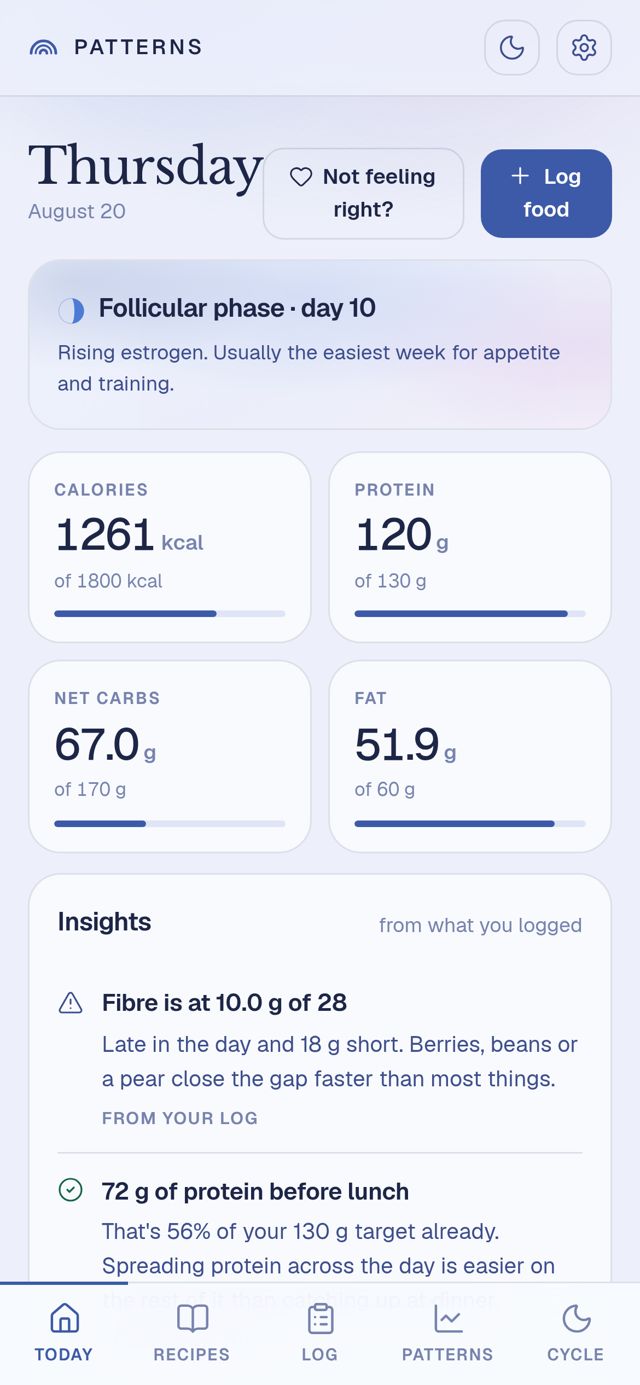
Track calories, macros and micronutrients alongside your cycle and the rest of your health — so what you eat finally has context.

Food is not the only thing worth tracking, and neither is your period. Tell Archie what you ate, how you moved, when your period started or how you are feeling. He asks what he needs to know and puts it in the right place.
Talk or type, whichever suits the moment. Nothing is recorded until you confirm it, and Archie’s voice and manner are a setting — including a plain one with no name for you and no small talk.
Sometimes talking is easiest. Sometimes the package is already in your hand.
Tell Archie what you ate. He asks what he needs and puts it in the log.
The barcode, when the box is already in your hand.
Photograph the nutrition panel and it reads the numbers off the label.
Foods, your favorites, and the meals you have logged before.
Yesterday's breakfast again, in one tap.
Calories and protein matter. So do iron, fiber, calcium, magnesium, folate, potassium and the B vitamins. Patterns tracks the whole picture rather than three colored rings.
Nutrition needs change with age, goals and life stage. Patterns moves the numbers that actually move, instead of leaving you on one generic set forever.
The requirement is 18 mg a day while you are cycling and 8 mg after menopause — more than double. Most trackers do not know the difference exists.
Calcium rises from 1,000 to 1,200 mg at 51. Magnesium steps up at 31. Patterns moves the target on the birthday instead of leaving you on a number that expired.
Computed from your height, weight, age, activity and goal — with a floor that refuses to recommend less than your body burns at rest.
Sitting alongside all of it, so a change in appetite, weight or cravings is never read in isolation.
Reference values follow the US Dietary Reference Intakes, and every figure says where it came from. They are population numbers rather than a prescription — pregnancy, breastfeeding and a number of conditions change them, and that is a conversation for a doctor rather than an app.
Two pounds on the scale. A week of stronger cravings. Lower energy, or appetite that changed without you deciding to. Patterns keeps your cycle behind the nutrition timeline, so those changes have context instead of every day being treated the same.
Your fiber intake has fallen below your target in the week before each of your last three periods.
Your weight rises about 2 lb in the five days before your period and returns to baseline within three days of it starting.
Your calorie intake climbed across the six days before your period in each of your last three cycles.
No prescribed cycle-syncing diet, and no assumption that every woman responds the same way. Every insight can show you the days behind it — how many cycles it looked at, how many agreed, and how big the change was — so you can check the pattern rather than take the app’s word for it. The questions it asks are fixed and written down in advance, and it reports the ones that came back flat too.
He already has the context you chose to track.
Your history becomes something you can talk to — and every answer opens the days it was drawn from.
Save your own or open one somebody shared. Every recipe carries calories, macros and whatever micronutrients its ingredients actually report — and goes straight into your log by weight, not by an eighth of a pan nobody cut evenly.

A nutrition tracker is only as good as its data. Patterns separates what was read off a product label from USDA reference values and from figures that are estimated or incomplete — on every nutrient, every time.
| Per serving | Amount | |
|---|---|---|
| Calories | 165 | kcal |
| Protein | 12.4 | g |
| Sodium | 191 | mg |
| Calcium | 170 | mg |
| Magnesium | 18.4 | mg |
We would rather show you uncertainty than give you a confident guess.
Track what you eat. Tell Archie what happens. Let Patterns read it against the rest of your health — and start learning what works for yours.